
Deed Types in Warrick County
Warrick County deed records trace every transfer of land. They also trace every name signed onto a recorded instrument. You can search Warrick County deeds by grantor or grantee. Then follow each legal description and document reference back through a chain of title. The Recorder's holdings reach beyond deeds alone. They cover mortgages, releases, liens, plats, surveys, contracts, and easements that can touch a parcel. Online tools help. But the counter, copy service, old deed books, and State Library microfilm fill the gaps. Remember that a recorded deed is evidence, not a title opinion.
| Deed Type | What It Does | Common Use |
|---|---|---|
| Warranty deed | Conveys the stated interest with title promises | An ordinary sale |
| Quitclaim deed | Passes only the interest the grantor has | Family transfer or title cleanup |
| Personal-representative deed | Conveys through an estate representative | Probate or estate sale |
| Survivorship or transfer-on-death instrument | Supports a transfer after a death | Death-transfer research |
| Tax deed | Records a transfer tied to the tax-sale process | Delinquent-tax property |
Other filings sit beside deeds in the Recorder's system. A mortgage, mechanic lien, sewer lien, federal tax lien, easement, restriction, affidavit, or power of attorney can all affect a parcel without moving full ownership. Read the whole document family and its parties before threading anything into a deed chain.
Warrick Recorder Document Families
The Warrick County Recorder accepts a wide span of instruments. These include deeds, mortgages, assignments, releases, real-estate contracts, powers of attorney, planned developments, plats, surveys, affidavits, mechanic liens, sewer liens, federal tax liens, assumed business names, and UCC filings. That breadth matters. A chain of title can hinge on any of these. A corrective affidavit, a release, a plat, or an estate instrument matters just as much as a deed. Visit the office in Boonville. It sits at One County Square, Suite 230, and is open weekdays from 8 a.m. to 4 p.m. Call 812-897-6165 or email recorder@warrickcounty.gov when an online entry lacks an image. Recorded documents are public, and copies are available in the office or online. The Recorder's county page displays the filing scope and online service links.
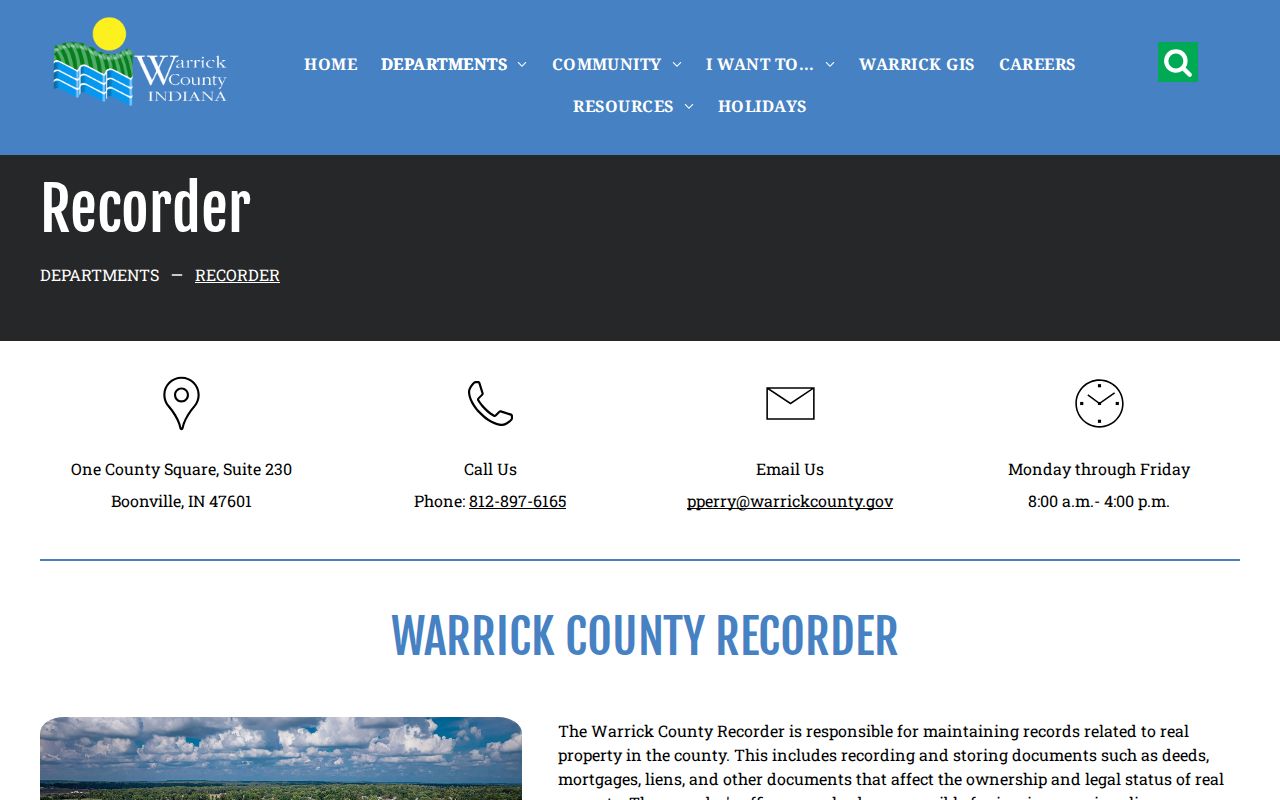
Warrick County lets searchers pull recorder documents through an official copy route. The page lists the document families the Recorder handles. It also lists the same-day cutoff for orders and the links a Warrick County deed search depends on. Deed records, mortgages, liens, and releases each fall under that list.
The Tapestry entry page is one county-linked search route. Warrick County also links Laredo. But official material publishes no Warrick-specific field inventory. It also publishes no earliest online year for either route. So treat any cutoff you hear about as unconfirmed.
Warrick Recording Fees and Copies
The Recorder posts a fixed schedule for recording and copies. Confirm the current amounts on the official fee page before submitting a document.
| Mortgage | $55 |
|---|---|
| Deed or other document | $25 |
| Mechanic lien | $25 with one first-class mailing; $2 each extra mailing |
| Copy, 11 by 17 or smaller | $1 per page |
| Copy larger than 11 by 17 | $5 per page |
| Certification | $5 per document |
Payment options are simple. Cash, check, and card are all accepted. A requester may pay online and ask the Recorder to send a copy by fax or email. Keep in mind that certification is a separate act from buying a plain copy. Before filing or ordering deed records, check the fee schedule. The current Recorder fee schedule is the authority.
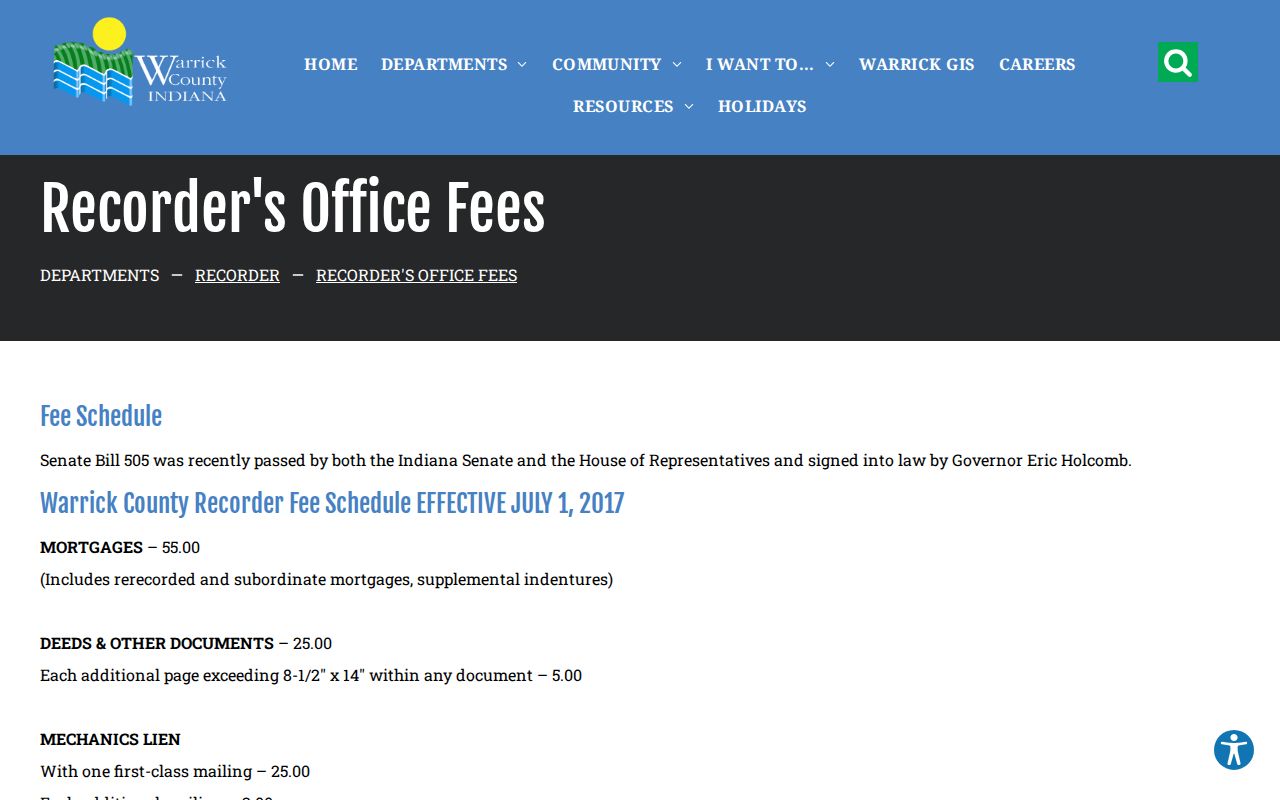
The schedule distinguishes recording charges from per-page copy and per-document certification fees.
Warrick Deeds Before the Counter
Recording comes after other offices sign off. A deed, contract purchase, easement, or plat needs both Assessor and Auditor approval. The stamps must come first. The Auditor also lists a $10 property-transfer charge per parcel. Warrick's same-day cutoff is 2:30 p.m.; anything accepted later gets the next day's recorded date. That timing matters when you line up a closing packet. It also affects the tax roll and the public index. Documents must satisfy Indiana and county format rules. The fee page requires the preparer's name, proper margins, and at least 10-point type. It also requires printed names matching signatures. A complete notary block is needed, plus the grantee's physical address. The page asks for an affirmation that reasonable care was used to redact Social Security numbers. Warrick rejects certain blanket or partial releases embedded in a multiple-transaction instrument. Note: The Recorder cannot draft a deed or fill out a legal form. It cannot notarize a document or advise on the transfer.
Follow Warrick Grantors and Grantees
A grantor-grantee index turns on names, dates, and document references. Start with the newest known owner and legal description. Locate that owner's purchase instrument, where they appear as grantee. The grantor on that deed is the prior owner. Search that party as grantee in an earlier period, then keep repeating the walk backward.
- Copy the current parcel's full legal description and present deeded-owner name from the property card.
- Find the owner's acquiring deed. Record its date, document ID or book and page, instrument type, grantor, grantee, and legal text.
- Search the grantor as an earlier grantee. Test initials, married names, middle names, entity suffixes, trustee, estate, and personal-representative forms.
- Match each result by legal description, acreage, lot and block, or section, township, and range. A shared surname is not enough.
- When the online trail ends, carry the last book, page, party, and date to Recorder books or State Library microfilm.
- Grantor
- The party transferring an interest.
- Grantee
- The party receiving the stated interest.
- Chain of title
- The linked sequence of recorded ownership instruments for the same land.
- Book and page
- A volume-and-page reference used to retrieve an older recorded document.
- Instrument number
- A unique filing reference assigned to a recorded document.
Let the legal description stay your thread. Street numbers change, and a current APN may not exist before a split. The county-linked Tapestry service offers an online entry point for indexed land records.
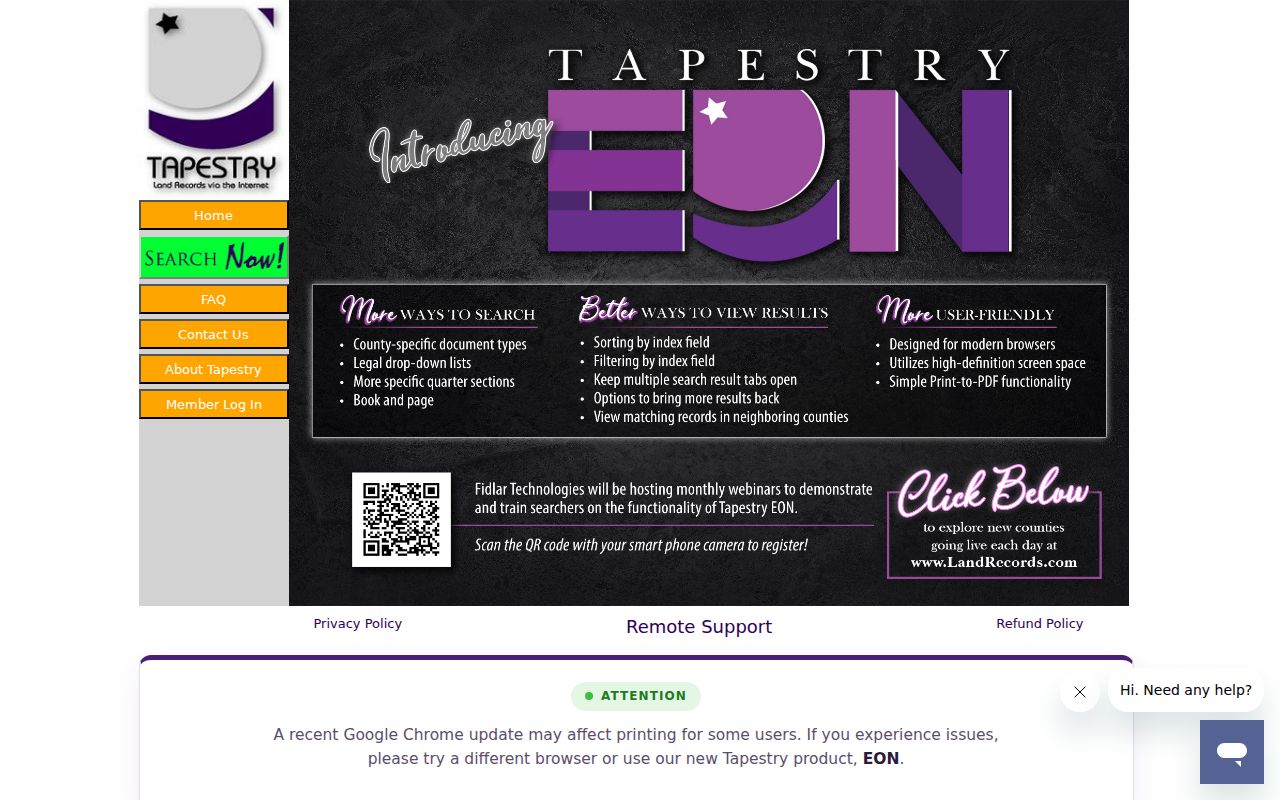
That entry screen is a search aid only. Warrick's official pages do not state the exact online coverage start year.
A Warrick Parcel Split Story
One county property card shows how splits work in practice. It records a 2009 division. The division came from a parent parcel in the 87-04-33-101 family. The new parcel is 87-04-33-103-002.000-006. The transfer table keeps a 2009 warranty-deed row plus an older 1900 entry. Meanwhile, the legal description names Parcel 2 Butcher Minor Sub. Small details like these are the model for hard deed work. When Warrick County deed records seem to stop at a new APN, try several angles. Search the parent number, the subdivision or tract name, the transfer party, and the recorded reference. Move forward through the split instrument or plat to the child parcel. A current street search alone may never expose that bridge.
Historic Warrick Deed Books
Warrick County was formed in 1813 out of Knox County. That makes its earliest deed books old. They are among the oldest land records in the region. The Indiana State Library microfilm inventory catalogs Deed Records A1 through 60. These cover 1813 to 1901. A separate deed run covers 1813 to 1834. Grantor and grantee index volumes 1 through 9 span 1814 to 1901. Administrators and Commissioners Deed Records from 1881 to 1901 form their own distinct series. These reels push a deed chain back past the modern portal. One caution applies. The inventory itself warns it is preliminary and may not be current. Treat it as a finding aid. Then confirm the reel, book, or page can be viewed or copied before counting on it. Not every transfer shows up as a routine sale. Early probate, partition, and court books often bridge the gap. The State Library holds probate and will materials dating to the nineteenth century. It also holds partition records from 1880 to 1941. The Clerk remains the custodian of current probate and court files.
Plats Shape Warrick Deed Research
Somewhere in a Warrick deed chain, the land description usually shifts. Acreage and section calls give way to a subdivision lot. Local examples include Villas of Oak Grove PUD, Bellmoore Landing Section 1 Corrected Plat, Action Trailer Sub, and Butcher Minor Sub. A corrected plat is more than neighborhood color. It can pin down the exact lot label. It can also settle an easement, dedication, common area, or parent tract a later deed depends on. Each office keeps a different slice. The Recorder holds plats, planned-development instruments, surveys, and easements. The County Surveyor maintains a legal survey record book, section-corner material, tie cards, and plats. The Area Plan Commission keeps subdivision and parcelization approvals. A proposed lot is not yet a legal parcel. Tie the planning approval back to the recorded plat itself first. Bellmoore Landing offers a useful lesson. Its corrected-plat wording carries a hint. A searcher should query both the subdivision name and the correction or replat instrument. A street address alone may pull up the current card. Yet it can miss the document that actually defined the lot.
Obtain a Warrick Deed Copy
Begin with any online image that matches the right party and legal description. No image? Then give the Recorder the document ID or book and page. Include the recording date, grantor and grantee, and the parcel description. Requests work at the counter, by phone or email. The county's online payment plus fax or email process works too. Ask for a certified copy when the receiving office or transaction demands one. A plain portal print suits research fine. It is not, however, a certified public record. Indiana APRA can also help identify an existing office-held record. The agency need not create a new chain report for a requester.
Recorded, not guaranteed. Warrick County deed records show accepted filings, not a title opinion; unrecorded interests and unresolved defects can still exist.
Need the address-to-parcel route first? Use the Warrick County property search before diving into deeds. Keep internal research notes separate from any certified copy meant for formal proof.